
Integrate Your Spiritual and Energy-based Work Into Psychotherapy Without Risking Your License
You don’t need to “switch to coaching” to practice in integrity.
You need clinical language, theory alignment, and documentation that can actually hold the depth of the work you do.
I help unconventional mental health therapists translate somatic, intuitive, spiritual, and energy-based practices into ethical, defensible clinical practice so they can stop hiding, stop second-guessing themselves, and practice with clarity and confidence.
🖤 How I Can HelpIntegrate Your Spiritual and Energy-based Work Into Psychotherapy Without Risking Your License
You don’t need to “switch to coaching” to practice in integrity.
You need clinical language, theory alignment, and documentation that can actually hold the depth of the work you do.
I help unconventional mental health therapists translate somatic, intuitive, spiritual, and energy-based practices into ethical, defensible clinical practice so they can stop hiding, stop second-guessing themselves, and practice with clarity and confidence.
🖤 How I Can HelpAbout Dr. Tina Vitolo
Hi! I am Dr. Tina Vitolo. I am a licensed clinical social worker and I have my doctorate in social work. My dissertation researched the impact of complementary and alternative interventions in clinical social work practice.
 THE BLACK SHEEP THERAPIST®
THE BLACK SHEEP THERAPIST®
THE BLACK SHEEP THERAPIST®
THE BLACK SHEEP THERAPIST®
THE BLACK SHEEP THERAPIST®
THE BLACK SHEEP THERAPIST®
THE BLACK SHEEP THERAPIST®
THE BLACK SHEEP THERAPIST®
THE BLACK SHEEP THERAPIST®
THE BLACK SHEEP THERAPIST®
THE BLACK SHEEP THERAPIST®
THE BLACK SHEEP THERAPIST®
THE BLACK SHEEP THERAPIST®
THE BLACK SHEEP THERAPIST®
THE BLACK SHEEP THERAPIST®
THE BLACK SHEEP THERAPIST®
THE BLACK SHEEP THERAPIST®
THE BLACK SHEEP THERAPIST®
THE BLACK SHEEP THERAPIST®
THE BLACK SHEEP THERAPIST®
THE BLACK SHEEP THERAPIST®
For Therapists Who Have Always Felt “Too Much” for the System
You might love the depth of psychotherapy, but you’ve always known that healing doesn’t only happen through traditional talk therapy.
Over the years, you’ve invested deeply in your growth and training.
You’ve studied Reiki.
You’ve trained in intuitive development.
You’ve explored oracle or Tarot as reflective tools.
You’ve learned somatic practices, energy work, or spiritual frameworks that expanded the way you understand healing.
And yet somewhere along the way, many therapists find themselves in a strange place.
Highly trained.
Deeply intuitive.
But professionally split.
You know these practices support your clients in meaningful ways, but you were never shown how they fit inside the structure of psychotherapy.
So instead of integrating what you’ve learned, you’re left trying to figure out:
How to talk about this work clinically
What actually belongs in your documentation
What boards, supervisors, or colleagues would consider acceptable
Whether you’re supposed to keep these parts of your work separate from therapy altogether
You’re not alone in that confusion.
The system wasn’t built for integrative, intuitive, embodied clinicians, but that doesn’t mean you have to leave the field to do this work.
The system was never designed to help therapists bridge clinical practice with spiritual or energy-based traditions.
But that doesn’t mean the bridge doesn’t exist.
It just means someone has to show you how to build it. Heyyyy, that's me!

the fear isn't about doing something wrong
It’s About Not Knowing How to Defend What You Do
Most therapists aren’t scared because they’re reckless.
They’re scared because the rules are vague, guidance is nonexistent, and nobody taught them how to translate their work into clinical language professional boards actually respect.
So they end up:
Staying quiet about how they really work
Using paperwork that doesn’t reflect their practice
Over-documenting out of fear, or avoiding documentation altogether
Considering coaching, not because they want to… but because it feels safer
That tension doesn’t make you ethical.
It makes you exhausted.
I’ve Lived in Both Worlds, and I Built the Bridge
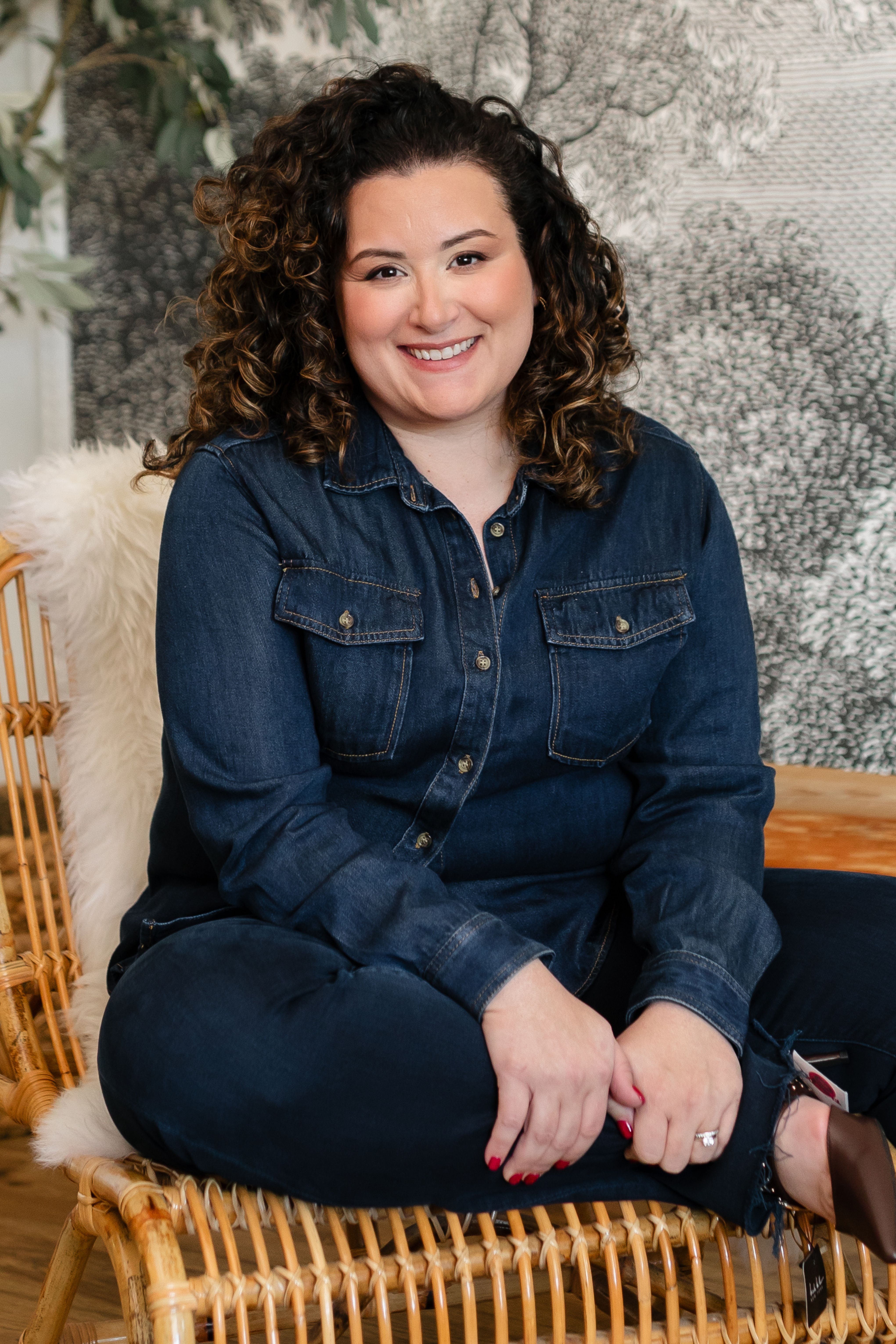
I’m Dr. Tina Vitolo, DSW, LCSW, and I know this tension from the inside.
The more I became aligned with my own spiritual and intuitive development, the more isolated I began to feel inside the mental health field.
I loved psychotherapy.
I respected the ethics and responsibility that come with holding a clinical license.
But I also knew that healing often unfolds through intuition, embodiment, spiritual insight, and energetic awareness in ways that traditional training rarely acknowledges.
For a while, it felt like I didn’t fully belong in either space.
I wasn’t willing to abandon clinical practice.
But I also wasn’t willing to pretend that important parts of healing didn’t exist.
I’m Dr. Tina Vitolo, DSW, LCSW, and I know this tension from the inside.
The more I became aligned with my own spiritual and intuitive development, the more isolated I began to feel inside the mental health field.
I loved psychotherapy.
I respected the ethics and responsibility that come with holding a clinical license.
But I also knew that healing often unfolds through intuition, embodiment, spiritual insight, and energetic awareness in ways that traditional training rarely acknowledges.
For a while, it felt like I didn’t fully belong in either space.
I wasn’t willing to abandon clinical practice.
But I also wasn’t willing to pretend that important parts of healing didn’t exist.
So instead of walking away from the profession, I started digging deeper into it.

I studied clinical theory more closely.
I examined ethics codes and state board regulations.
I looked carefully at how scope of practice, informed consent, and professional standards actually function in real-world therapy.
Over time, something became very clear.
The issue wasn’t that these practices were forbidden or outside the profession.
In many cases, our ethics codes and professional standards actually encourage clinicians to expand their knowledge, develop new skills, and integrate innovative approaches that benefit clients.
The real problem was that therapists were given almost no guidance on how to do that responsibly.
No safe space to figure out how to integrate these modalities in a way that clearly aligns with scope of practice, ethics, and professional accountability.
So many clinicians are left trying to figure it out alone.
And when you’re isolated and uncertain, the last thing you’re going to do is move confidently inside a professional gray area.
And definitely not in a field, where “professional” colleagues are quick to judge and report you to the board.



Freedom Isn’t Recklessness. It’s a Framework
Integrating spiritual, somatic, intuitive, or energy-based practices into psychotherapy isn’t about ignoring professional standards.
It’s about understanding them deeply enough to work within them with clarity and intention.
When therapists know how to ground their work in clinical theory, clearly communicate their approach, and document their interventions in ways that reflect professional expectations, something shifts.
The fear starts to fade.
Because the work is no longer vague or difficult to defend.
It becomes structured, transparent, and aligned with the ethical responsibilities of clinical practice.
That’s why I developed an evidence-informed framework that helps therapists translate integrative practices into language that fits within psychotherapy.
This framework connects unconventional modalities with:
Established clinical theory
Ethical and scope-of-practice standards
Transparent informed consent
Defensible clinical documentation
So therapists can integrate the depth of their work while remaining grounded in the expectations of the profession.
Because professional freedom doesn’t come from ignoring the rules.
It comes from understanding how to work within them.
How We Turn Your Practice Into Something You Can Stand Behind
Most therapists already have the instincts, training, and client experience that inform how they work.
What’s usually missing isn’t skill.
It’s structure.
Many therapists I work with have spent years investing in training in somatic work, spiritual traditions, intuitive development, or energy-based practices.
And somewhere along the way, they start hearing the same message over and over:
“Maybe you should just move into coaching.”
But for many clinicians, that suggestion never really fits.
You became a therapist because you care deeply about clinical responsibility, ethical practice, and the depth of psychotherapy.
You don’t want to abandon that.
You want to understand how the work you already do can exist inside the container of therapy.
That’s where this process begins.
Together, we take the work you already do and translate it into a clear, defensible framework that reflects both your clinical responsibilities and your unique approach to healing.
What It Looks Like to Work Together
1. Let’s Chat About Your Practice
We begin by looking closely at your practice, your training, and the areas where you feel uncertain, stuck, or professionally split.
This conversation helps clarify what you’re already doing and where the gaps in language, documentation, or structure may be creating unnecessary fear.
2. Translate What You Already Know
Most therapists come in with extensive training in somatic, spiritual, or energy-based modalities.
The challenge isn’t learning more.
It’s understanding how those approaches align with clinical theory, ethical standards, and scope of practice.
This is where we begin building the language and structure that allows your work to be clearly understood within psychotherapy.
3. Build a Practice That Reflects the Full Depth of Your Work
From there, we develop the practical elements that support your practice, including how you describe your work, how it appears in informed consent, and how your documentation reflects the interventions you use.
Instead of feeling like you’re operating in a gray area, your work becomes grounded, transparent, and professionally aligned.
You don’t have to figure this out alone.
If you’re ready to stop guessing and start building a practice you can stand behind, there are several ways we can work together depending on the level of support you’re looking for.
Want to see if I’m actually legit before booking a call?
Fair.
Start here.
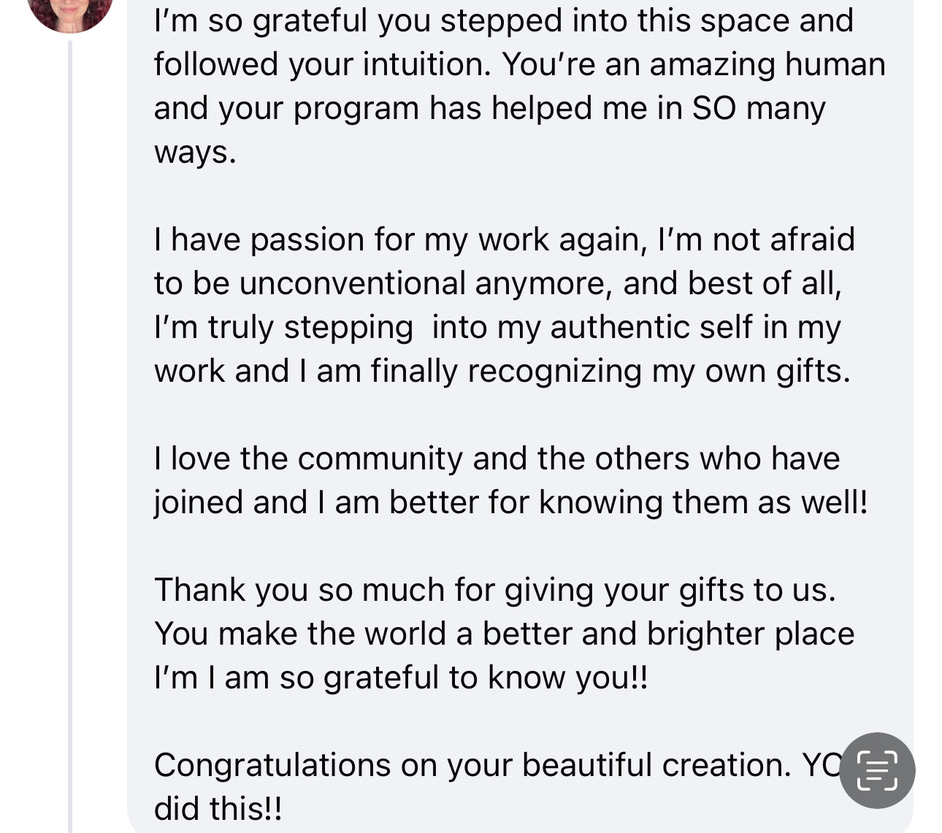
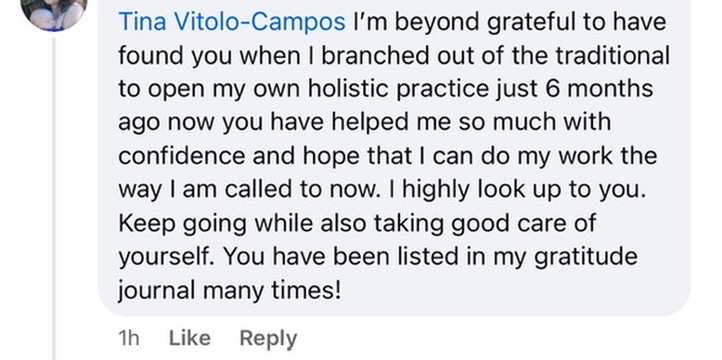
Explore the trainings, community, and resources that have helped thousands of therapists build practices they can actually stand behind.
📚 The Book: The Black Sheep Therapist®
A practical guide for therapists who want to integrate spiritual and unconventional practices into psychotherapy without abandoning ethics, theory, or professional responsibility.
🎓 CE-Approved Trainings
Continuing education courses designed to help therapists ethically integrate complementary and alternative interventions into clinical practice.
🐑 The Black Sheep Therapist® Community
A space for unconventional clinicians who want support, conversation, and real discussions about integrative therapy without judgment.
⭐ Client Stories & Testimonials
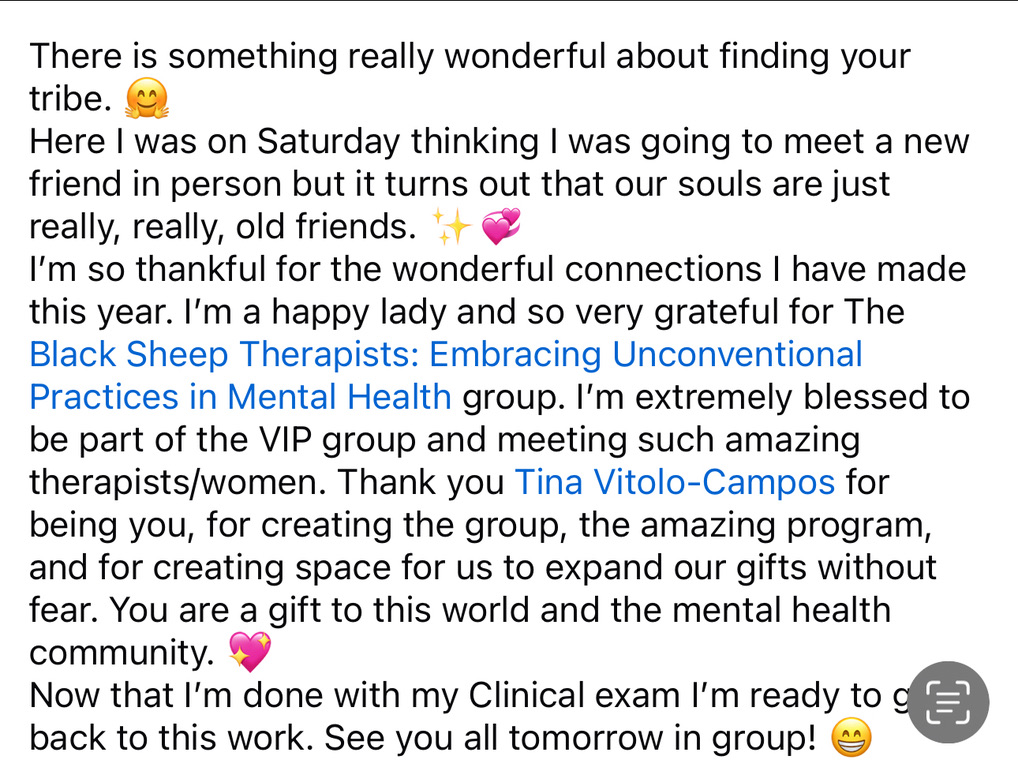
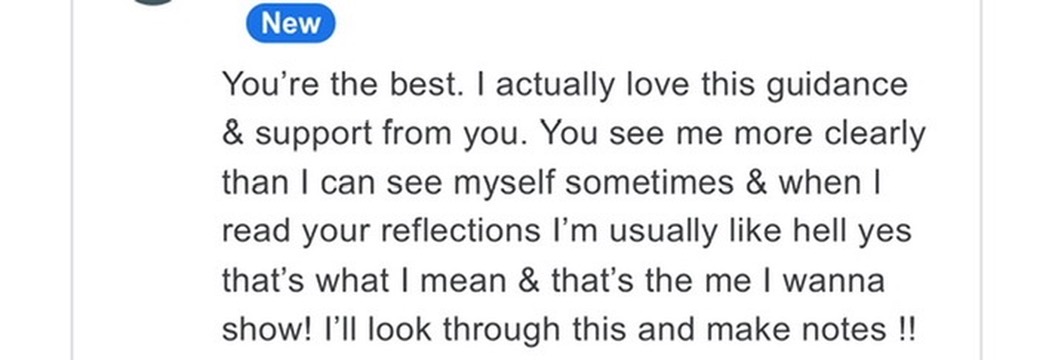
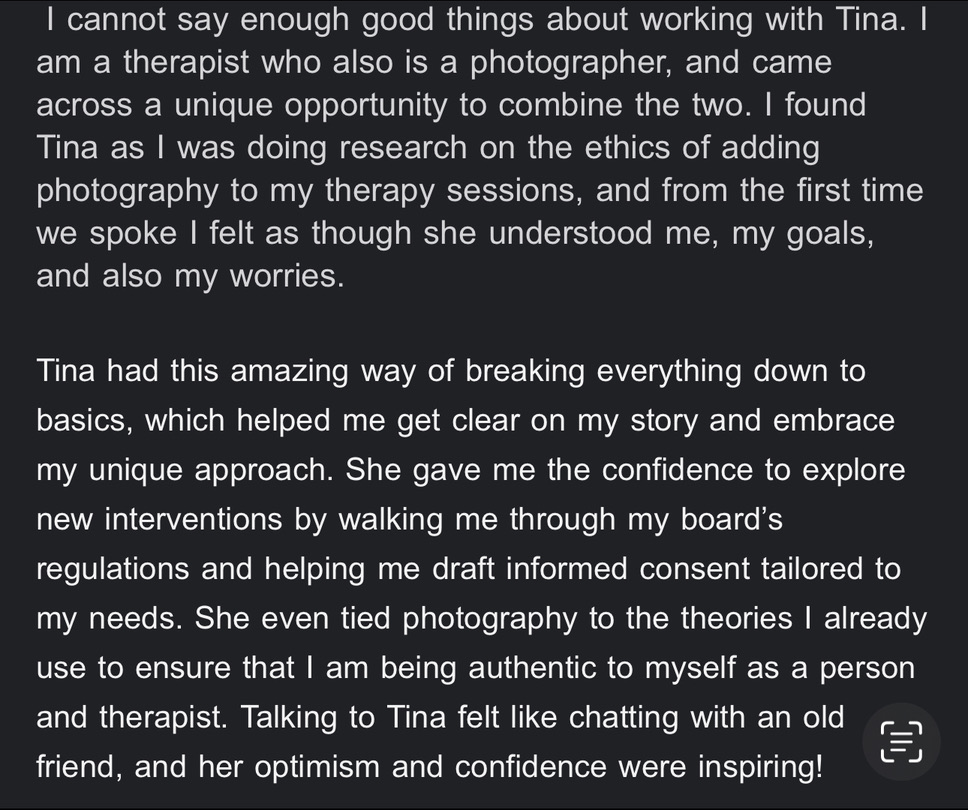
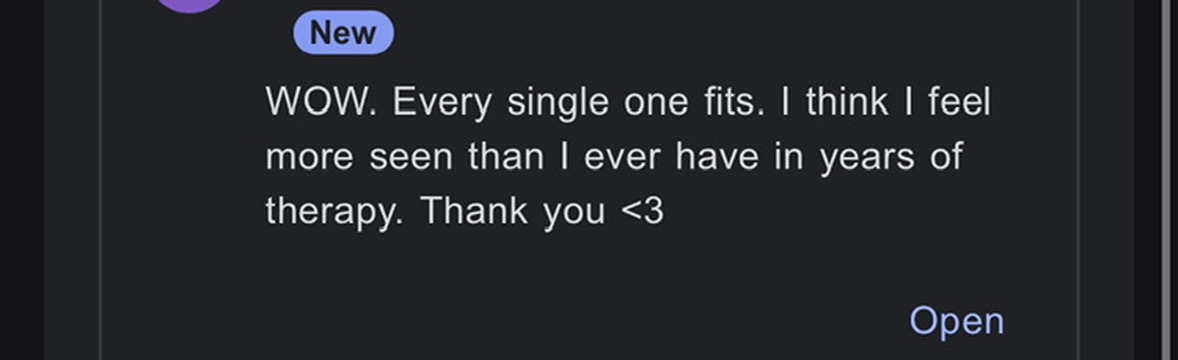
Hear directly from therapists who have built confident, aligned practices using these frameworks.
Ready to talk about your practice?
Want to see if I’m actually legit before booking a call?
Fair.
Start here.
Explore the trainings, community, and resources that have helped thousands of therapists build practices they can actually stand behind.
📚 The Book: The Black Sheep Therapist®
A practical guide for therapists who want to integrate spiritual and unconventional practices into psychotherapy without abandoning ethics, theory, or professional responsibility.
🎓 CE-Approved Trainings
Continuing education courses designed to help therapists ethically integrate complementary and alternative interventions into clinical practice.
🐑 The Black Sheep Therapist® Community
A space for unconventional clinicians who want support, conversation, and real discussions about integrative therapy without judgment.
⭐ Client Stories & Testimonials
Hear directly from therapists who have built confident, aligned practices using these frameworks.
Ready to talk about your practice?
You’ll Feel at Home Here If…
You’re licensed (or licensure-track) and in private practice or plan to
You integrate, or want to integrate, somatic, spiritual, intuitive, or energy-based work in therapy
You care deeply about ethics, scope, and client autonomy
You’re done practicing in a rigid and manualized box
This isn’t about breaking rules.
It’s about learning how to rewrite them responsibly.
What Changes When You Stop Hiding
You speak clearly about how you work, without over-explaining
Your paperwork reflects your actual practice
Your documentation feels aligned instead of forced
You stop flinching when colleagues question you
Your clients feel your confidence, and trust it
This is what professional freedom actually looks like.
You Don’t Have to Figure This Out Alone
If you’re tired of guessing, shrinking, or staying silent, let’s talk.
Join the Black Sheep Therapist® Community
A free space for unconventional clinicians who want clarity, confidence, and community, without judgment or performative professionalism.
Inside the group, we talk about:
Ethical integration
Documentation and language
Real-world practice questions
The stuff nobody taught you
Join the Black Sheep Therapist® Community
A free space for unconventional clinicians who want clarity, confidence, and community, without judgment or performative professionalism.
Inside the group, we talk about:
Ethical integration
Documentation and language
Real-world practice questions
The stuff nobody taught you